The Assignment:
Purpose: The purpose of this project is to learn about different communication styles and identify your primary style.
Overview: Complete the Discover Your Communication Style questionnaire to help you identify your style. Deliver a 5- to 7-minute speech at a club meeting about your communication style and its impact on your professional and/or personal relationships. If you are uncomfortable discussing your communication style, you may speak about the communication styles you have encountered and how they impact you. Your speech should not be a report of the content of this project.
Your speech can be persuasive, humorous, informational, or crafted in any style that appeals to you and supports your speech content.
_________________________________________________________________________________________________________
Good afternoon Madam Toastmaster, fellow Toastmasters & guests,
In a world where everyone seems to be talking louder, reacting faster, and listening less, I believe one of the most powerful things a person can do is make someone else feel heard.
Communication can build trust, repair relationships, inspire confidence… OR destroy all of those things in a single moment.
And the difference often comes down to not just what we say, but how we say it.
When I completed the communication style assessment in my learning pathway, results showed my strongest communication style is supportive. I thought, ‘Well… that sounds about right.’ But the more I reflected on it, I recognized more deeply how much our communication style shapes our relationships, our workplaces, and even the way we handle conflict.
The supportive communication style is described as calm, patient, dependable, and relationship-focused. People with this style are often good listeners and prefer harmony over confrontation. That description honestly felt very personal to me.
I’ve never been someone who will engage in (unhealthy) conflict. In fact, I can count on one hand the number of times I’ve truly raised my voice in my entire life. It’s just not who I am. I’ve always believed that once words are spoken, especially in anger, they can never really be taken back. You may apologize later, but people still remember how those words made them feel.
Because of that, I try to communicate carefully and thoughtfully. I want people to feel heard, respected, and understood, even when we disagree.
Over time, I’ve realized that listening is one of the greatest strengths a person can have. Most people are not listening to understand. They’re listening to respond. They’re simply waiting for their turn to talk. But when someone genuinely listens to you, it changes the entire conversation.
I’ve noticed that friends, family members, and coworkers often come to me when they need advice or support. Not because I always have the right or perfect answer – because I definitely don’t, but because they know I’ll listen without judgment. Often, people don’t need someone to fix their problems. They just need and want someone who makes them feel seen and heard.
But being supportive does come with challenges.
One challenge is avoiding conflict too much. Sometimes, instead of addressing a problem immediately, I’ll stay quiet longer than I should because I don’t want to hurt someone’s feelings or create tension. But I’ve learned that avoiding conflict completely doesn’t always solve anything. Healthy communication requires difficult conversations.
People sometimes assume that avoiding conflict means avoiding difficult conversations altogether. But that’s not true for me.
I may not raise my voice, and I don’t believe in speaking out of anger, but I absolutely believe in standing up for what is right. I believe there’s a difference between creating conflict and resolving conflict.
You can communicate firmly without being disrespectful. You can disagree without attacking someone personally. You can stand your ground while still remaining professional, tactful, and calm.
In many situations, staying calm actually gives your words more power. Emotional control is power.
Anyone can react emotionally in the heat of the moment. But it takes patience, self-control, and maturity to communicate with respect and tact when emotions are high.
I believe conflict resolution is one of the most important communication skills we can develop – in the workplace, with our families, friendships, and everyday life.
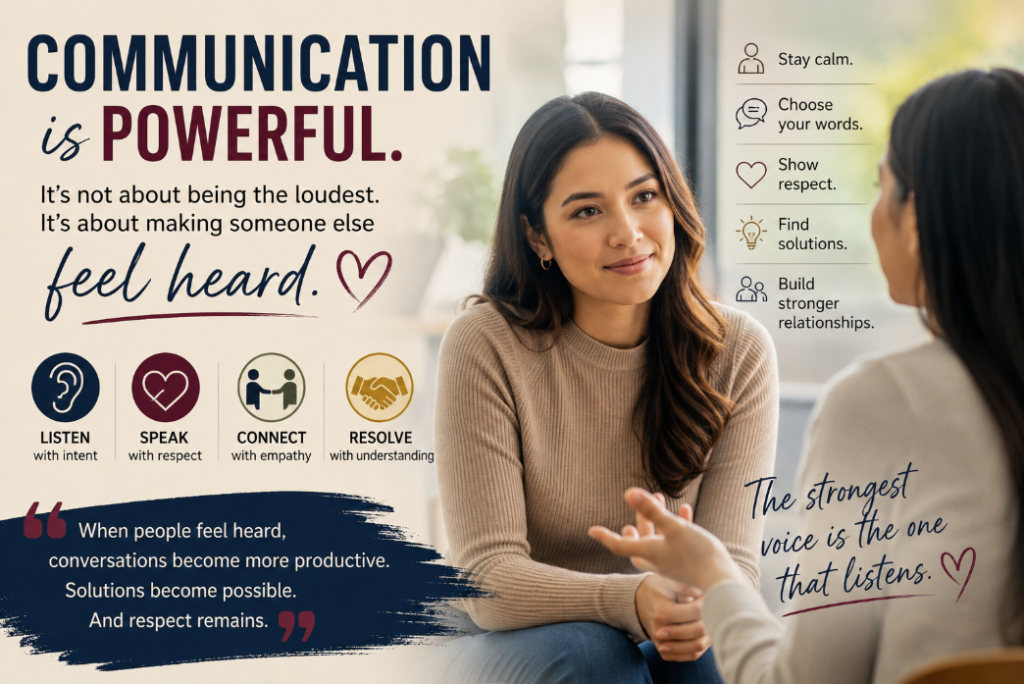
When people feel heard, conversations become more productive. Defensiveness lowers. Solutions become possible. And even if two people still disagree, they can walk away with mutual respect instead of resentment.
Another interesting thing about my assessment was that I also scored fairly high in direct and analytical communication styles. That surprised me just a little, but then I realized it actually makes sense most especially working in a Corporate environment here at Love’s and most definitely in the military.
In personal relationships, I’m very supportive and relationship-focused. But in work situations or when solving problems, I can become much more analytical and direct. I like structure, organization, and finding solutions. When something needs to be done, I focus on details and results.
So while I naturally lead with empathy, I can adapt depending on the situation.
Effective communication is not forcing everyone to communicate the same way but it is understanding people well enough to adjust your approach.
Some people communicate very directly and want you to get straight to the point. Others are analytical and need facts, details, and time to process information. Some people are outgoing and expressive, while others are quieter and more reflective.
The better we understand those differences, the better we can connect with each other.
And I personally think the world could use a lot more of that right now.
We live in a time where people often react quickly, interrupt each other, argue online, and speak or write before ever thinking of subsequent consequences. But communication is POWERFUL. Words can encourage people, inspire people, comfort people, or deeply hurt people.
That’s why I try to remember that every conversation matters and while we may not remember every conversation we have in life, we will always remember how someone made us feel.
This project reiterated for me that communication is not about being the loudest person in the room.
The strongest voice is more often the calm one.
The strongest voice is the one that chooses words carefully.
The strongest voice is the one that stands up for what is right without tearing others down.
The strongest voice is the one that listens before judging.
And in a world where so many people are waiting to speak, I think becoming someone who truly listens may be one of the most powerful things we can do.
If someone leaves a conversation with me feeling respected, understood, encouraged, heard, or even just a little less alone, then I believe I’ve communicated successfully. And you can do the same.
Thank you.