Dynamic Leadership Level 2 Speech #1: The purpose of this project is for the member to identify their primary leadership styles or styles and share some aspect(s) of their primary leadership style or discuss leadership styles in general.
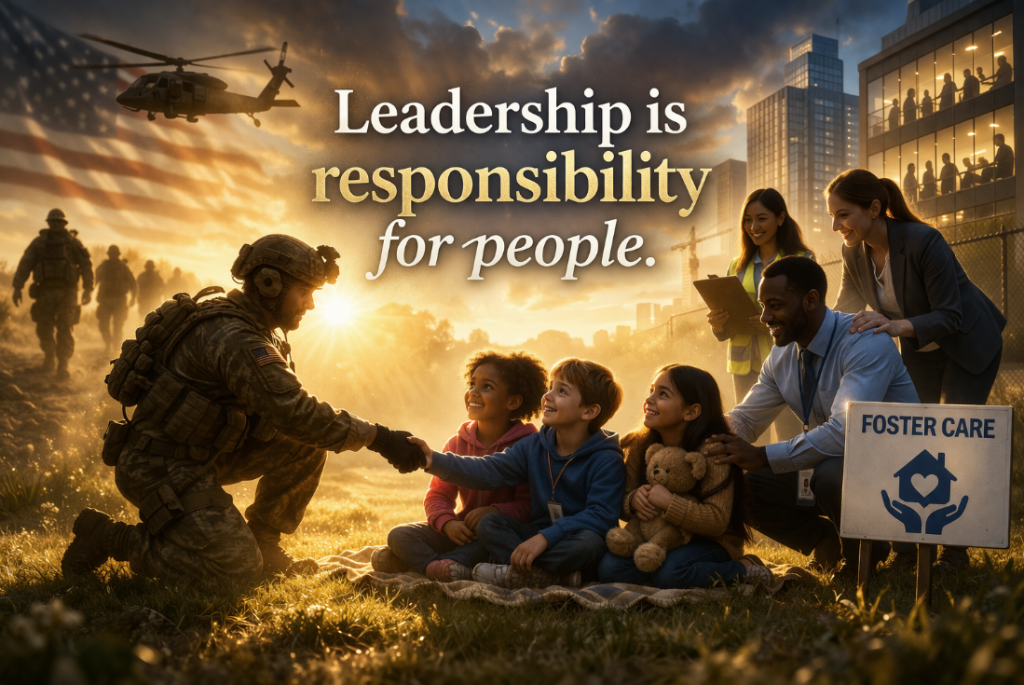
“Leadership is Responsibility”
When people talk about leadership today, we hear a lot of words like collaboration, empowerment, and influence.
And those are all important.
But over the course of my life, in the Army, in my career here at Love’s, and through foster care, I’ve come to believe leadership comes down to something much greater.
Responsibility for people.
And the most meaningful leadership lessons I’ve learned came from those three very different places. Each one shaped how I think about leadership today, and each one reinforced that the responsibility we carry as leaders is never really about ourselves but about the people beside us.
The Army taught me my earliest and perhaps most serious lessons about leadership.
Over the course of my time in the Army, I deployed three times. And there is one unspoken responsibility that every Soldier understands:
You are responsible for the person standing next to you.
Not just for your own job.
Not just for your own safety.
But for bringing everyone back home.
In that environment, leadership quickly becomes less about rank and all about trust. The commanders I respected the most were the ones who followed through on what they said they were going to do. Their words matched their actions. They held themselves to the same standards they expected from everyone else.
But then the most powerful leadership lessons come from examples of what not to do.
I once served under a commander who had a practice he called “Self-Selection.” If someone made a mistake or a poor decision that disrespected the uniform, he would bring them up on stage in front of the unit and explain what they had done wrong – stating he or she had “Self-Selected”. His message – I believe… was that people should take accountability for their actions.
But later, when that same commander engaged in behavior that clearly violated the very standards he enforced, and ultimately led to his removal from position, it became one of the clearest examples of hypocrisy many of us had ever witnessed.
In another instance, when a serious sexual harassment complaint surfaced, the command team wanted the matter handled quietly within the unit because they did not want outside attention on the organization. Instead of focusing on the misconduct itself, the responsibility was shifted onto the victim. She was told that if she had simply stayed in her lane and not concerned herself with the situations of other Soldiers, she would not have found herself in that position.
That Soldier was me and that moment reinforced for me that leadership must protect the people who come forward, not make them feel responsible for someone else’s inappropriate and unacceptable behavior.
Those experiences shaped the foundation of my leadership style. They reinforced the importance of integrity, accountability, and responsibility for those around you.
When I came to Love’s, I found myself applying many of the same lessons I had learned in the Army, but in a completely different environment.
One of those lessons is that leadership requires humility. You never assume you know everything, and you never assume the best ideas only come from the people at the top.
If you want to understand an organization, you have to listen to the people doing the work every day.
The cashiers.
The shift leaders.
The team members in the stores.
Those individuals often have the clearest understanding of what’s really happening in the operation.
So instead of only looking upward for answers, I made it a point to listen across every level of the organization. I asked questions, paid attention, and learned from the people around me.
That approach reflects two parts of my leadership style.
First, a democratic approach – recognizing that the combined knowledge and perspective of a team often leads to the best solutions.
And second, a coaching mindset – creating opportunities for people to contribute, share their knowledge, and grow.
But leadership doesn’t always show up in big decisions or strategy meetings but rather shows up in the smallest moments.
I wrote a simple birthday card for a team member. Nothing elaborate – just a note wishing her a happy birthday and letting her know she was appreciated.
When she opened it, she became emotional and told me no one in her life had ever given her a birthday card before… I was stunned.
That moment showed me that leadership isn’t always about directing people or solving problems but simply recognizing someone as a person and letting them know they are important.
But perhaps the most meaningful leadership lessons in my life haven’t happened in uniform or in the workplace.
They’ve happened this past year at home through foster care.
Children entering foster care often arrive carrying uncertainty, fear, and experiences that most of us will never fully understand or ever be able to comprehend.
And in those moments, leadership doesn’t look like direction or authority.
It looks like patience.
It looks like listening.
It looks like creating a space where someone feels safe enough to believe that things can get better.
Trust cannot be demanded in that environment.
It has to be earned through consistency, empathy, care, and unconditional love.
These raw and sacred experiences have strengthened another important part of my leadership approach – an altruistic leadership style, one centered on serving others, understanding their needs, and helping them move toward a better future.
People perform best – whether they are Soldiers, colleagues, or children – when they know they matter.
When I look back across these three parts of my life – the Army, Love’s, and now foster care – the leadership lessons are remarkably consistent.
Leadership requires integrity.
Leadership requires humility.
And leadership requires compassion.
In the Army, leadership means bringing your people home.
At Love’s, leadership means learning from your team and helping them succeed.
And in foster care, leadership means creating hope where it may not have existed before.
At the end of the day, leadership is measured by the people we protect, the people we develop, and the people we lift along the way.
Because, as stated at the start of this speech, leadership is responsibility for people.